Reference range
A statistical interval from a reference population. It is not automatically a diagnostic threshold or treatment target.

Clinical resource
The labs worth knowing — and what actually matters clinically.
FNP CREATED | EVIDENCE-BACKED
Reference intervals are not universal. Unless a threshold is standardized for diagnosis or management, ranges in this resource are typical and should be checked against the reporting laboratory. Interpretation should account for age, sex, pregnancy, assay, specimen, medications, acute illness and the patient's baseline.
A statistical interval from a reference population. It is not automatically a diagnostic threshold or treatment target.
A change from baseline may matter before a value becomes formally abnormal. Rate and direction often carry more clinical information than one isolated result.
Most important laboratory questions are solved by combinations: Hgb + MCV + RDW + retics; Na + serum osm + urine osm + urine Na; AST/ALT + ALP + bilirubin; creatinine/eGFR + UACR.
Medications, hydration, kidney/liver function, timing, specimen quality and acute physiologic stress can change the number without changing the underlying diagnosis.
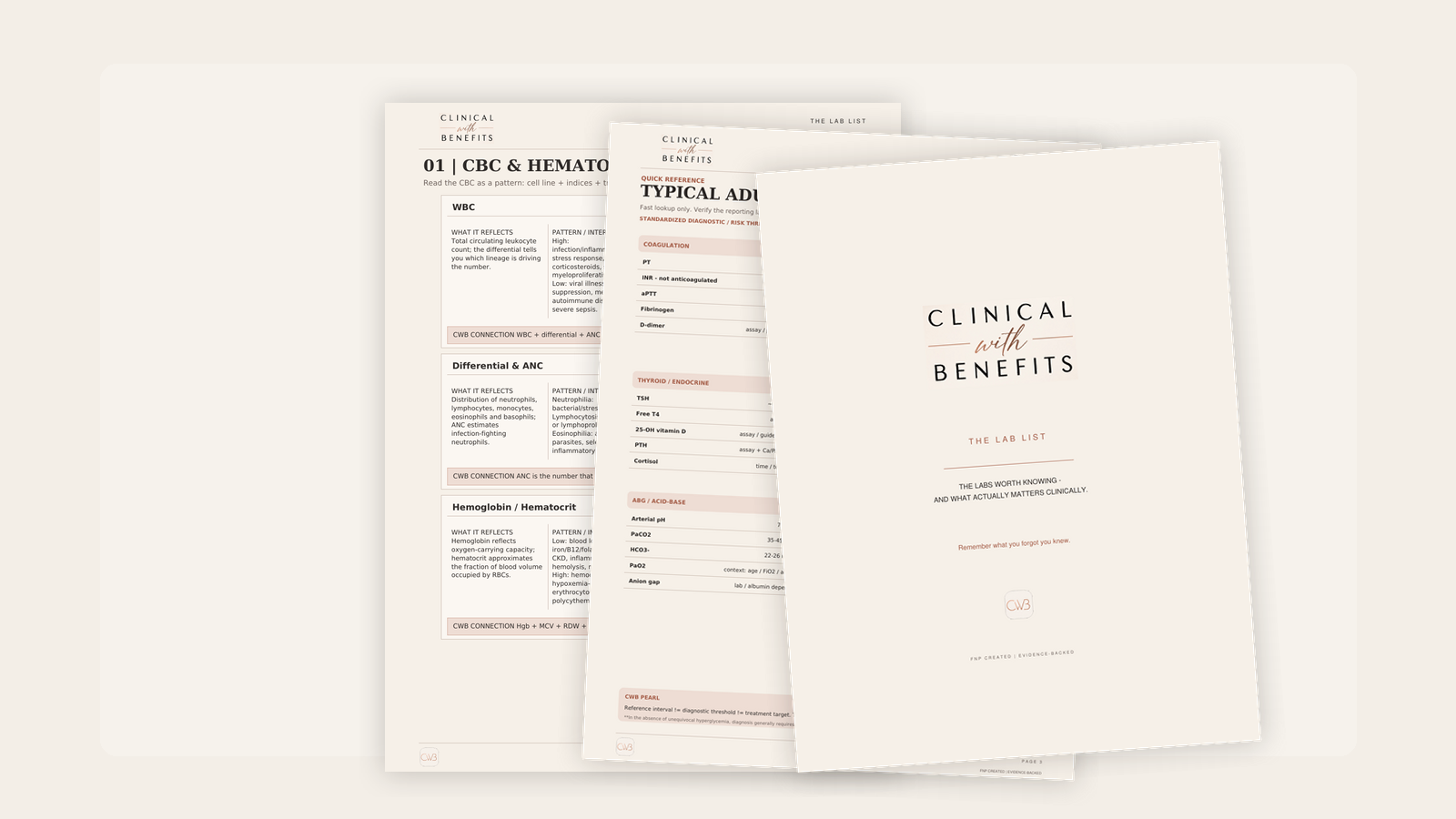
Subscriber printable
Same clinical goodness. Less scrolling.
Read the CBC as a pattern: cell line + indices + trajectory + clinical context.
Typical adult: ~4.0–11.0 x10³/µL; use local range.
Reference intervals vary by sex, age, pregnancy status, altitude and lab.
MCV typical adult: ~80–100 fL; RDW assay-specific.
Platelets typical adult: ~150–450 x10³/µL.
Numbers matter, but symptoms, rate of change and physiology determine urgency.
Typical: ~135–145 mmol/L.
K: ~3.5–5.0 mmol/L; Mg: ~1.7–2.4 mg/dL.
CO₂: ~22–29 mmol/L; chloride: ~98–106 mmol/L.
Total calcium: ~8.5–10.5 mg/dL; phosphorus: ~2.5–4.5 mg/dL.
Kidney interpretation is filtration + albuminuria/proteinuria + trajectory + clinical context.
Creatinine: ~0.6–1.3 mg/dL; eGFR staging G1–G5.
UACR A1 <30, A2 30–300, A3 >300 mg/g.
Serum osmolality: ~275–295 mOsm/kg.
Separate injury pattern, cholestasis and synthetic function.
AST: ~10–40 U/L; ALT: ~7–56 U/L; ALP: ~44–147 U/L.
Total bilirubin: ~0.2–1.2 mg/dL; albumin: ~3.5–5.0 g/dL.
Cardiac biomarkers and coagulation tests answer specific questions; they do not diagnose the entire syndrome by themselves.
Assay-specific; use the reporting lab's assay and pathway.
PT: ~11–13.5 sec; INR: ~0.8–1.1 without anticoagulation; aPTT: ~25–35 sec.
Fibrinogen: ~200–400 mg/dL; D-dimer is assay/pathway-specific.
Separate chronic glycemia, current glucose, hormonal feedback and nutritional patterns.
Fasting glucose 70–99 mg/dL; A1C normal <5.7%, prediabetes 5.7–6.4%, diabetes ≥6.5%.
TSH: ~0.4–4.0 mIU/L; other assays are context-specific.
Serum iron: ~60–170 mcg/dL; TIBC: ~240–450 mcg/dL; TSAT: ~20–50%.
These markers support a clinical hypothesis; they rarely identify the source by themselves.
Assay and protocol-specific.
Interpret organism, collection, number of positive sets and clinical context.
Specific gravity: ~1.005–1.030; urine pH: ~4.5–8.0.
Use physiology and the clinical question rather than treating a result in isolation.
Arterial pH 7.35–7.45; PaCO₂ 35–45 mmHg; HCO₃⁻ 22–26 mmol/L.
Triglycerides fasting generally <150 mg/dL; risk thresholds are guideline-specific.
Lab-, timing- and specimen-specific.